Quick answer
Use a ball valve for quick on and off control at taps, geysers and bathroom points. Use a gate or sluice valve on main lines where full flow matters and the valve is rarely operated. Use a butterfly valve for larger pipes where you need quick isolation in a small space. Fit a non-return valve after a pump, and a pressure reducing valve where pressure is too high.
Valves look simple from the outside, but picking the wrong one causes real problems: a geyser that cannot be isolated, a pump that loses prime every night, or a main line valve that jams the one day you need it. This guide covers the valves we sell most at Hindustan Traders and where each one belongs.
Ball valve
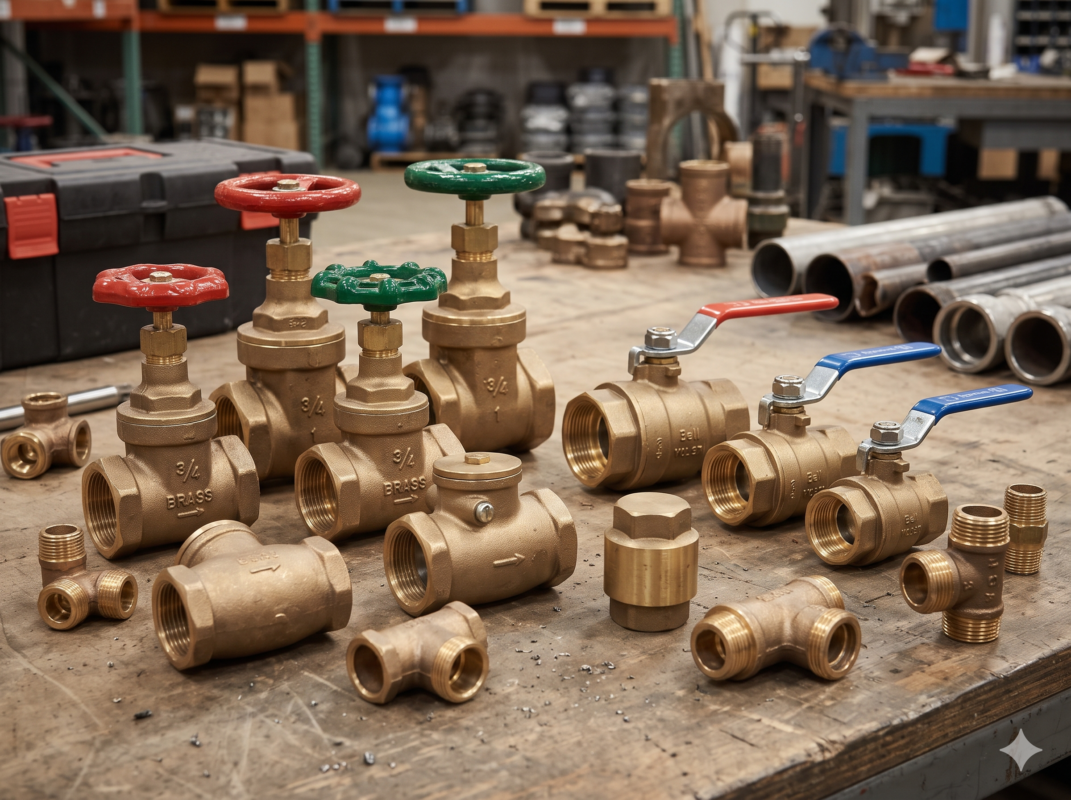
A ball valve has a ball with a hole through it. A quarter turn of the lever lines the hole up with the pipe (open) or turns it across (closed). It is quick to operate and shuts off tightly, which is why it is the most common valve in home plumbing.
- Best for: geyser lines, bathroom isolation, tank outlets, washing machine points
- Materials: brass for most home use, CPVC and UPVC for plastic lines
Gate valve and sluice valve
A gate valve lifts a flat gate out of the flow path using a handwheel. When fully open there is very little restriction, so it suits main lines. It takes several turns to open or close. In larger cast iron sizes used on water mains, the same design is usually called a sluice valve.
- Best for: main inlets, pump room isolation, water supply mains
- Not ideal for: frequent operation or partial throttling
Butterfly valve
A butterfly valve has a disc that rotates a quarter turn on a shaft. It is compact and light compared with a gate valve of the same size, which matters on bigger pipes. Smaller sizes use a lever, larger ones a gearbox.
- Best for: larger water lines, pump stations, HVAC and utility lines
Non-return valve (NRV or check valve)
An NRV lets water flow in one direction only. After a pump, it stops water running back down when the pump switches off, which protects the pump and keeps the line full. At the bottom of a suction pipe, a foot valve does a similar job and also strains the water.
Air valve
Air trapped at the high points of a pipeline reduces flow and causes noise and water hammer. An air valve releases that air automatically. It is common on longer mains and pump delivery lines.
Pressure reducing valve (PRV)
If you are on a lower floor of a tall building, or have a powerful booster pump, water pressure can be high enough to damage mixers, flush valves and geysers. A PRV on the inlet brings the pressure down to a steady, safe level.
Quick selection table
| Need | Valve to use |
|---|---|
| Shut off a bathroom or geyser quickly | Brass or CPVC ball valve |
| Isolate the main water line | Gate valve, or CI sluice valve on larger mains |
| Isolate a large pipe in a small space | Butterfly valve |
| Stop backflow after a pump | Non-return valve |
| Remove trapped air from a pipeline | Air valve |
| Reduce high pressure | Pressure reducing valve |
| Protect a pump from debris | Y-strainer or foot valve |
CI or brass?
Brass valves are used for threaded home and building lines, typically in smaller sizes. Cast iron (CI) valves are used for flanged lines in larger sizes, such as society pump rooms and factory mains. For heavy industrial duties there are ductile iron and resilient seated designs.
Browse brass valves, CI valves and industrial valves, or send us the size and use on WhatsApp and we will suggest the right one.